How to Write SEO-Friendly Blog Posts That Rank on Google and AI Search
Creating a blog post is easy. Creating one that consistently ranks on Google, appears in AI-generated responses, and drives organic traffic is much more challenging. With search evolving rapidly, content creators need to optimize for more than just traditional search engines. Modern content should also be structured for answer engines and AI-powered search platforms.
If you’re wondering how to write SEO-friendly blog posts, this guide will walk you through proven strategies that improve visibility, enhance user experience, and help your content perform across Google Search, AI Overviews, ChatGPT, Gemini, and other generative search platforms.
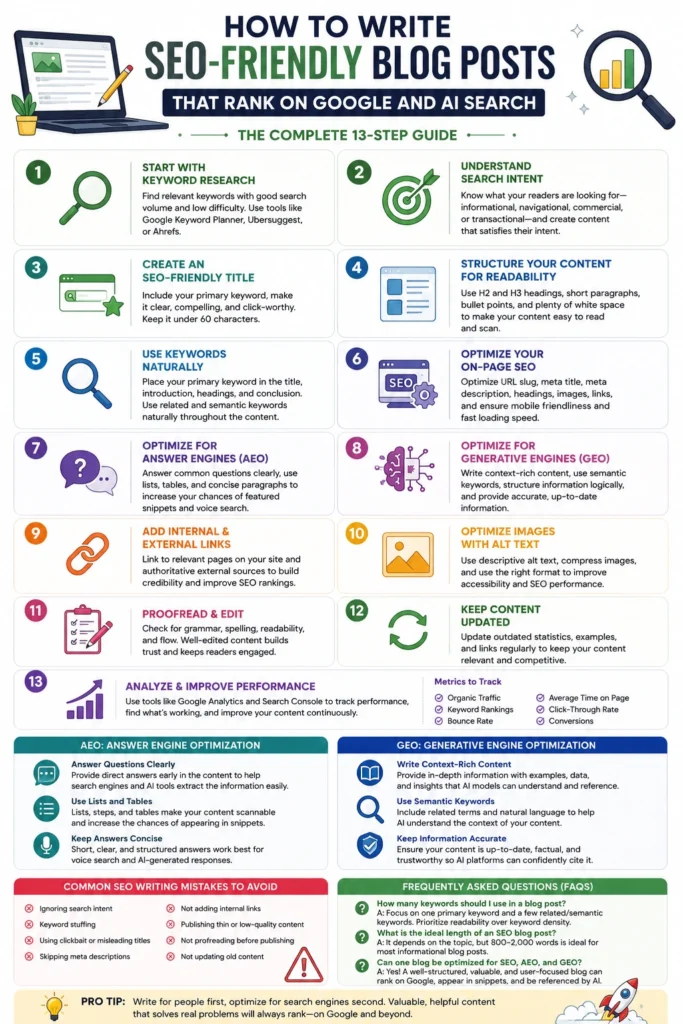
What Is an SEO-Friendly Blog Post?
An SEO-friendly blog post is content that is optimized to help search engines understand your topic while delivering value to readers. It answers a specific question, targets relevant keywords, follows a logical structure, and encourages users to stay engaged.
Unlike outdated SEO practices, modern SEO content writing isn’t about stuffing keywords into every paragraph. Instead, it’s about creating high-quality, informative content that satisfies search intent and answers users’ questions better than competing pages.
Why SEO, AEO, and GEO Matter
Search is no longer limited to typing keywords into Google. Today, users also rely on AI assistants and answer engines to find information quickly.
- SEO (Search Engine Optimization) helps your content rank higher in search engine results.
- AEO (Answer Engine Optimization) improves your chances of appearing in featured snippets, voice search, and direct AI-generated answers.
- GEO (Generative Engine Optimization) ensures AI models can understand, summarize, and reference your content accurately.
Optimizing for all three helps your content remain visible as search technology continues to evolve.
Start with Keyword Research
Every successful blog begins with keyword research.
Choose one primary keyword that closely matches what your audience is searching for. Then identify secondary and semantic keywords that naturally support your topic.
For this article, the primary keyword is how to write SEO-friendly blog posts. Supporting keywords include SEO blog writing, SEO writing guide, blog SEO best practices, search intent, content optimization, and on-page SEO.
Free tools like Google Keyword Planner, Google Search suggestions, and AnswerThePublic can help you discover relevant keywords. If you have access to premium tools such as Ahrefs or Semrush, use them to analyze keyword difficulty, search volume, and competitor rankings.
Understand Search Intent
Keyword research alone isn’t enough. You also need to understand why someone is searching for a particular query.
This is known as search intent.
For example, someone searching for how to write SEO-friendly blog posts wants practical guidance with actionable steps—not a history of SEO or a sales pitch.
Before writing, ask yourself:
- What problem is the reader trying to solve?
- What information are they expecting?
- What questions might they ask next?
Answering these questions makes your content more useful and increases the likelihood of ranking in both traditional and AI-powered search results.
Create an SEO-Friendly Title
Your title is one of the first things users notice in search results. A compelling title encourages clicks while helping search engines understand your content.
An effective SEO title should:
- Include the primary keyword.
- Clearly communicate the benefit.
- Stay concise and easy to read.
- Avoid misleading clickbait.
For example:
How to Write SEO-Friendly Blog Posts That Rank on Google and AI Search
This title tells readers exactly what they’ll learn while naturally incorporating the target keyword.
Structure Your Content for Readability
A well-structured article is easier for readers to scan and easier for search engines to interpret.
Use one H1 heading for your title, H2 headings for major sections, and H3 headings for supporting information. Keep paragraphs short, use bullet points where appropriate, and break complex ideas into smaller sections.
Clear formatting improves readability, reduces bounce rates, and increases the chances of your content being selected for featured snippets or AI-generated summaries.
Use Keywords Naturally
One of the biggest mistakes in SEO blog writing is overusing keywords.
Instead of repeating the same phrase unnaturally, place your primary keyword in strategic locations such as the title, introduction, one or two headings, and conclusion. Support it with related phrases like SEO-friendly content, content optimization, organic traffic, and blog SEO best practices.
Search engines have become much better at understanding context, so writing naturally is far more effective than forcing keywords into every sentence.
Optimize Your On-Page SEO
Once you’ve written your blog, it’s time to optimize its on-page elements. These components help search engines understand your content and improve your chances of ranking.
Make sure your blog includes:
- A keyword-rich URL slug (for example: /how-to-write-seo-friendly-blog-posts)
- An engaging meta title and meta description
- Internal links to related blog posts
- External links to authoritative sources
- Descriptive image alt text
- A mobile-friendly layout with fast loading speeds
These small optimizations contribute to a better user experience and stronger search performance.
Optimize for Answer Engines (AEO)
Answer Engine Optimization (AEO) focuses on providing clear, direct answers that search engines and AI assistants can easily display.
To improve your chances of appearing in featured snippets and AI-generated responses:
- Answer common questions early in the article.
- Keep explanations concise and easy to understand.
- Use descriptive headings that reflect user queries.
- Include numbered lists and bullet points where appropriate.
For example:
What is SEO blog writing?
SEO blog writing is the process of creating content that is optimized for search engines while providing valuable, relevant information to readers. It combines keyword optimization, search intent, and quality writing to improve visibility in search results.
This format makes it easier for search engines and AI tools to identify and present your content as a direct answer.
Optimize for Generative Engines (GEO)
Generative Engine Optimization (GEO) helps AI-powered platforms understand, summarize, and reference your content accurately.
To create GEO-friendly content:
- Define important terms before using them.
- Organize information with logical headings.
- Write in a conversational yet informative tone.
- Support your points with accurate, up-to-date information.
- Use semantic keywords naturally throughout the article.
Instead of writing for algorithms, write for people while making your content easy for AI systems to interpret. Well-structured, context-rich content is more likely to be surfaced in AI-generated search experiences.
Common SEO Writing Mistakes to Avoid
Even well-written blogs can struggle if they overlook the basics. Avoid these common mistakes:
- Ignoring search intent.
- Stuffing keywords unnaturally.
- Writing vague or misleading headings.
- Skipping meta descriptions.
- Forgetting internal links.
- Publishing without proofreading.
- Using duplicate or thin content.
- Failing to update outdated articles.
Regularly reviewing and improving your content helps maintain its relevance and search visibility over time.
Frequently Asked Questions
How many keywords should I use in a blog post?
Focus on one primary keyword supported by several related and semantic keywords. Prioritize readability over keyword repetition.
What is the ideal length of an SEO blog post?
The ideal length depends on the topic and competition. For most informational content, articles between 800 and 2,000 words provide enough depth while remaining easy to read.
Can one blog be optimized for SEO, AEO, and GEO?
Yes. A well-structured article that answers user questions, uses relevant keywords naturally, and provides valuable information can perform well across traditional search engines, answer engines, and AI-powered search platforms.
Final Thoughts
Writing SEO-friendly blog posts is about more than ranking on Google. As search continues to evolve, successful content should also be optimized for answer engines and generative AI platforms.
Start with thorough keyword research, understand your audience’s search intent, structure your content clearly, and optimize your on-page elements. Then, enhance your blog with direct answers, logical formatting, and context-rich information that AI systems can easily interpret.
By combining SEO, AEO, and GEO best practices, you’ll create content that attracts organic traffic, answers users’ questions effectively, and remains relevant across the next generation of search experiences.
Whether you’re a business owner, marketer, or content writer, applying these strategies consistently will help your blog reach a wider audience and deliver long-term results.
At The Content Tactics, we believe that great content isn’t just written—it’s strategically optimized to inform, engage, and perform across every modern search platform.